
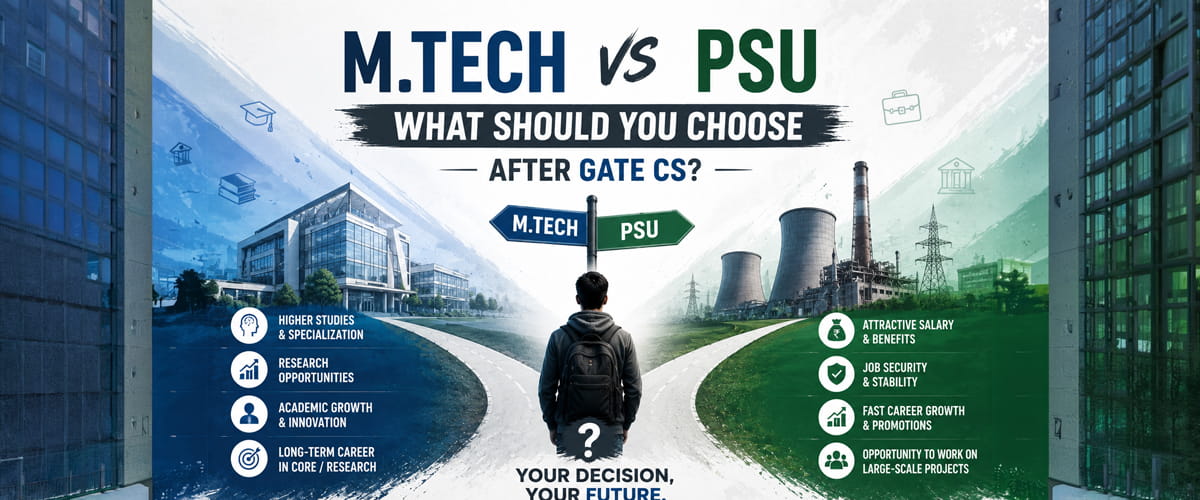
The score arrives. You have 65 in GATE CS. PSU notifications are out. M.Tech counselling has begun. The next 30 days will shape the next 30 years of your career — and most aspirants have nobody to walk them through the trade-offs honestly.
This article is that walk-through.
The Two Paths in One Sentence Each
M.Tech (IIT/NIT): Two more years of deep specialisation, a stipend during studies, and entry into research roles, R&D companies, top product firms, or PhDs and academia.
PSU job: Immediate ₹14–20 LPA CTC, government job security, structured 30-year career growth, and entry into India's national infrastructure or defence ecosystem.
Salary Comparison — The 5-Year View
| Year | M.Tech path (typical) | PSU path (typical) |
|---|---|---|
| Year 1 | Stipend ₹12,400/m | ₹14–20 LPA |
| Year 2 | Stipend ₹12,400/m | ₹15–22 LPA |
| Year 3 (placement) | ₹18–60 LPA (high variance) | ₹17–24 LPA |
| Year 5 | ₹25–80 LPA (variance widens) | ₹22–28 LPA |
The M.Tech path has a delayed start but a higher ceiling and much higher variance. PSU has a fast, stable start with a more predictable trajectory.
What M.Tech Actually Gives You
- Two years of deep technical specialisation in CS, ML, Systems, AI etc.
- Access to faculty research, publications, and global PhD pipelines
- The IIT/NIT brand on your CV — useful for product company placements
- Time to figure out career direction without immediate job pressure
- Stipend covers basics; you do not pay tuition out of pocket at most IITs
M.Tech is the right call if:
- You want a research, R&D or product engineering role
- You are considering PhD or academia long-term
- You want to switch from a non-CS UG to a CS career
- You enjoy deep technical work over operational management
What a PSU Job Actually Gives You
- Immediate financial independence — start earning at age 22–23
- Government job security with a structured pay scale
- Posting in tier-1 / tier-2 cities, often near family
- Defined career progression — E1 → E2 → E3 → ... with timelines
- Excellent work-life balance — typically 9-to-5 with weekends off
- Strong medical, leave and pension benefits
PSU is the right call if:
- Financial stability matters now (family support, loan repayment, etc.)
- You value predictability over upside variance
- You want to contribute to national infrastructure or defence
- You prefer urban postings near home
- You are not deeply drawn to research or product engineering
The Hidden Trade-Offs Nobody Mentions
Opportunity cost of M.Tech
Two years on a stipend means ₹30L–₹40L of foregone income vs starting in a PSU. If your placement multiplies post-M.Tech, you recover quickly. If you take an average software job after M.Tech, the opportunity cost may not pay back for 5+ years.
Lifestyle of PSU
PSU work is steady but rarely cutting-edge. Engineers who crave technical depth sometimes feel under-utilised after 5–7 years. Some move into management; some pursue executive MBAs; a few resign for product companies — but exits are rare.
The "M.Tech then PSU" path
Many M.Tech graduates also sit for PSU recruitment using their M.Tech-stage GATE score. This gives you both options — but your GATE score must be high enough to stay valid for two more cycles, and PSU notifications increasingly favour fresh GATE scores.
The Decision Framework — Three Questions
- Where do you want to be at 30? A PSU executive in your home city, or a senior engineer at a product company / research lab?
- How sensitive are you to financial uncertainty? M.Tech placements have wide variance. PSU does not.
- Do you actually enjoy deep technical work? If you do, M.Tech maximises that. If you do not, PSU is more honest.
What We Tell Our Students at i-Gate
There is no universal right answer. We have alumni thriving on both paths — some leading R&D teams at product companies post-M.Tech, others as senior managers at NTPC and BHEL with rich, balanced lives. The right answer is the one aligned with your priorities at age 22, not the one that sounds most impressive at a family dinner.
If you are still undecided, read our complete guide to PSU recruitment and weigh it against your specific M.Tech offers.