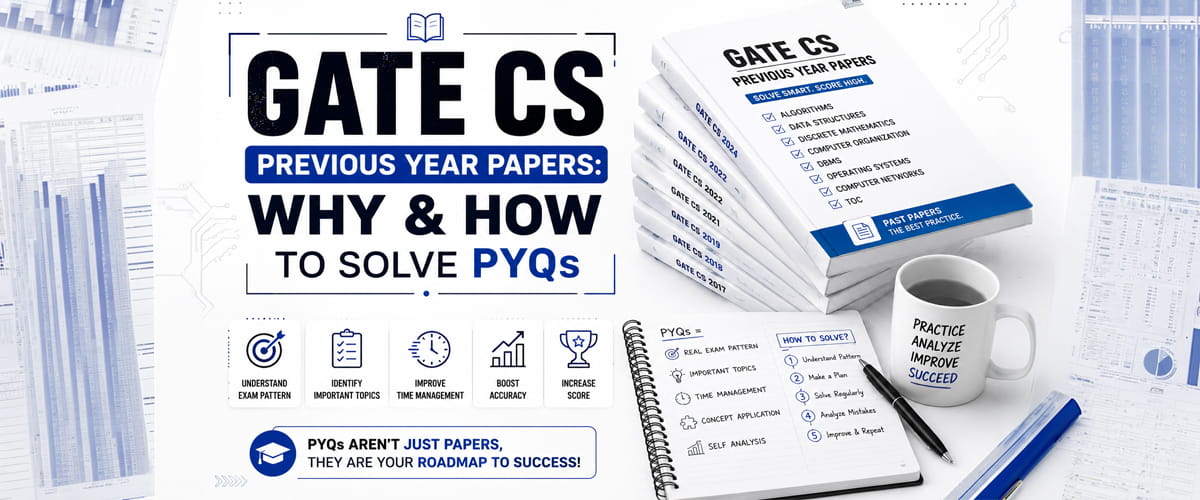
If we had to pick one preparation activity that contributes most to a strong GATE CS score, it would be solving previous year question papers. Not reading them. Not skimming the answer keys. Sitting down with paper and pen, attempting them as if they were the actual exam, and then analysing every error — that is what moves the needle.
Why PYQs Matter More Than Any Reference Book
- Pattern repeats. The same concepts come back in disguised forms — the framing changes, the underlying idea does not.
- Difficulty calibration. Books cover topics; PYQs reveal what GATE actually asks. Many book topics are out of scope for the exam.
- Time management. Solving PYQs under time pressure trains the speed instinct that no theory book can.
- Confidence. By the time you have solved 15 years of PYQs, the actual exam feels like another mock.
How Many Years of PYQs Should You Solve?
Minimum: 10 years (2015–2024). Ideal: 15 years (2010–2024). Pre-2010 papers are useful for concept exposure but the syllabus and difficulty pattern have evolved enough that they are lower-priority. Do not skip 2014 onwards — that is when the current paper structure stabilised.
The Right Way to Solve PYQs — Three Phases
Phase 1: Subject-Wise (during regular preparation)
As you finish each subject, immediately solve all PYQs from that subject in chronological order. This:
- Reinforces what you just learned
- Reveals which subtopics GATE actually emphasises
- Helps you identify your weak topics within the subject
Maintain a notebook: question number, subtopic, status (correct / incorrect / skipped), reason for error.
Phase 2: Year-Wise (final 6 weeks)
Once all subjects are done, attempt full year papers in 3-hour timed sessions. Start with 2014 and move forward. After each paper:
- Score honestly — no leniency on partial answers
- Categorise errors: concept gap, calculation, time pressure, misread
- Spend 2x the test time on review and re-derivation
Phase 3: Topic-Marathon (final 2 weeks)
Take a single high-yield topic — say, Page Replacement Algorithms — and solve every PYQ ever asked on it across 15 years. You will see the pattern. You will see the favourite traps. You will not get caught by them again.
Topics That Repeat Most Often
From our analysis of 2010–2024 GATE CS papers, the highest-frequency topics are:
| Subject | Highest-Frequency Topic |
|---|---|
| OS | Page replacement, semaphores, scheduling |
| Networks | Subnetting, sliding window, CRC |
| DBMS | Normal forms, SQL queries, indexing |
| Algorithms | DP recurrences, graph traversals, time complexity |
| TOC | Regular language closure, DFA minimisation |
| Compilers | LL/LR parsing, FIRST/FOLLOW |
| COA | Pipelining hazards, cache miss rate |
| Digital | K-map minimisation, flip-flop conversion |
What "PYQ Analysis" Actually Means
Most aspirants confuse "solving PYQs" with "checking answers". Real analysis means, for every wrong or skipped question:
- Why was this wrong / skipped?
- What is the underlying concept I missed?
- Where in my reference book is this covered?
- What three more problems should I solve to nail this concept?
Your error notebook is the highest-value artefact of your entire preparation. Re-read it every weekend.
Mock Tests vs PYQs — Use Both
Mocks simulate exam pressure with new questions. PYQs reveal exam patterns with proven questions. You need both. Read more on how many mock tests to take.
Final Word
If you only had time for one of: reading textbooks, watching lectures, or solving PYQs — pick PYQs. They are the closest you will get to the actual GATE paper before exam day. Treat them with the seriousness they deserve.