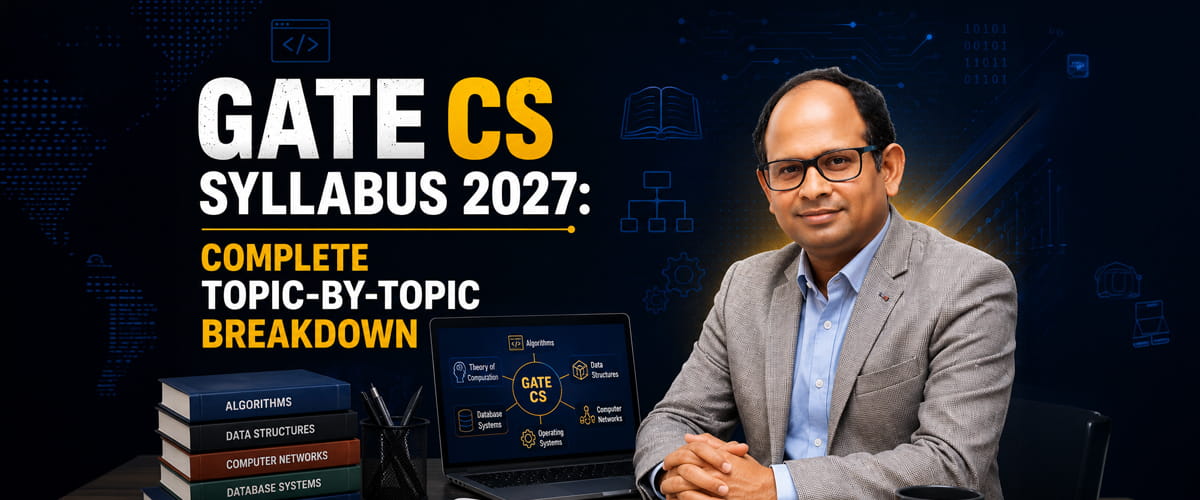
The GATE Computer Science syllabus has stayed broadly stable since 2016, but every aspirant must know it at the subtopic level — not just the section headings. Knowing "I have to study Operating Systems" is useless. Knowing "Page replacement algorithms have appeared in 8 of the last 10 years" is what converts effort into marks.
Below is the complete GATE CS 2027 syllabus with the subtopic detail you need, organised by section. The weightage figures are 5-year averages from our analysis of 2020–2024 papers.
Section 1 — Engineering Mathematics (~13 marks)
Discrete Mathematics
- Propositional and first-order logic
- Sets, relations, functions, partial orders, lattices
- Monoids, groups
- Graphs: connectivity, matching, colouring
- Combinatorics: counting, recurrence relations, generating functions
Linear Algebra
- Matrices, determinants
- System of linear equations
- Eigenvalues and eigenvectors
- LU decomposition
Calculus
- Limits, continuity, differentiability
- Maxima and minima, mean value theorem
- Integration
Probability & Statistics
- Random variables: discrete and continuous
- Mean, median, mode, standard deviation
- Conditional probability, Bayes theorem
- Normal, Poisson, binomial, exponential distributions
Section 2 — Digital Logic (~6 marks)
- Boolean algebra, K-maps, minimisation
- Combinational circuits: multiplexers, decoders, encoders, adders
- Sequential circuits: latches, flip-flops, counters, shift registers
- Number representation: fixed and floating point
Section 3 — Computer Organization & Architecture (~7 marks)
- Machine instructions and addressing modes
- ALU, data path, control unit
- Instruction pipelining: hazards, pipelining performance
- Memory hierarchy: cache, main memory, secondary storage
- I/O interface: interrupts, DMA
Section 4 — Programming & Data Structures (~10 marks)
- Programming in C: pointers, arrays, recursion, structures
- Stacks, queues, linked lists
- Trees: BSTs, heaps, AVL trees
- Graphs: representation, BFS, DFS
- Hashing
Section 5 — Algorithms (~8 marks)
- Asymptotic analysis: best, worst, average
- Divide-and-conquer, dynamic programming, greedy methods
- Graph algorithms: shortest path, MST, traversals
- Sorting and searching algorithms
- Algorithm complexity: P, NP, NP-complete
Section 6 — Theory of Computation (~7 marks)
- Regular languages, regular expressions, finite automata (DFA, NFA)
- Context-free languages, pushdown automata
- Turing machines, decidability, undecidability
- Pumping lemma for regular and CFL
Section 7 — Compiler Design (~5 marks)
- Lexical analysis, parsing (top-down, bottom-up)
- Syntax-directed translation
- Runtime environments, intermediate code generation
- Code optimisation
Section 8 — Operating System (~9 marks)
- Process management, threads
- CPU scheduling algorithms
- Inter-process communication, synchronisation, deadlocks
- Memory management: paging, segmentation, virtual memory
- File systems, disk scheduling
Section 9 — Databases (~7 marks)
- ER model, relational model, relational algebra, SQL
- Integrity constraints, normal forms (1NF–BCNF)
- File organisation, indexing (B and B+ trees)
- Transactions, concurrency control, recovery
Section 10 — Computer Networks (~8 marks)
- OSI and TCP/IP reference models
- LAN technologies (Ethernet)
- Data link: framing, error detection (CRC), MAC, sliding window
- Network layer: IPv4 addressing, subnetting, routing protocols
- Transport layer: TCP, UDP, congestion control
- Application layer: DNS, HTTP, SMTP, IP services
Section 11 — General Aptitude (15 marks)
- Verbal aptitude: grammar, vocabulary, comprehension
- Quantitative aptitude: arithmetic, algebra, geometry, data interpretation
- Analytical and spatial reasoning
Weightage Summary
| Section | Avg Marks |
|---|---|
| General Aptitude | 15 |
| Engineering Mathematics | 13 |
| Programming & Data Structures | 10 |
| Operating System | 9 |
| Algorithms / Networks | 8 each |
| COA / TOC / Databases | 7 each |
| Digital Logic / Compilers | 5–6 each |
Use this breakdown to build your six-month preparation roadmap and pick the right books for each subject.