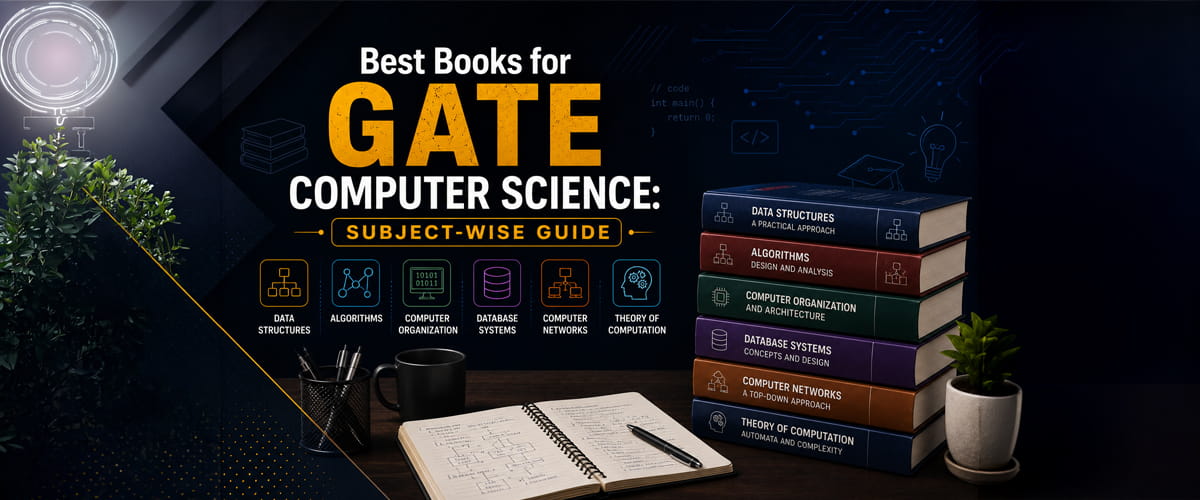
Aspirants routinely ask for "the complete book list for GATE CS" — and then they buy 25 books, read three, and panic. The truth is far simpler. For each subject you need one primary textbook for concepts and one problem source for practice. Anything beyond that is noise.
Below are the books we have recommended at i-Gate Bhilai for over a decade — chosen for their clarity, GATE-alignment and the quality of their solved examples. We have deliberately kept the list short.
Engineering Mathematics
- Primary: Higher Engineering Mathematics — B.S. Grewal. Covers calculus, linear algebra and probability with worked examples directly relevant to GATE.
- Discrete Math: Discrete Mathematical Structures — Kolman/Busby/Ross. Cleanest treatment of logic, set theory and graph theory.
Digital Logic
- Primary: Digital Design — M. Morris Mano. The standard text. Read chapters on combinational and sequential circuits thoroughly.
Computer Organization & Architecture
- Primary: Computer Organization & Embedded Systems — Carl Hamacher. Better suited to GATE than Patterson/Hennessy for the depth-vs-time trade-off.
- Pipelining specifically: selected chapters from Patterson & Hennessy.
Programming & Data Structures
- C Programming: Let Us C — Yashavant Kanetkar. For pointer and recursion fluency.
- Data Structures: Data Structures Using C — Reema Thareja, or Tenenbaum's classic text.
Algorithms
- Primary: Introduction to Algorithms — Cormen, Leiserson, Rivest, Stein (CLRS). Read the chapters on DP, greedy, graph algorithms and complexity. Skip the proof-heavy sections on first read.
Theory of Computation
- Primary: Introduction to Automata Theory, Languages and Computation — Hopcroft, Motwani, Ullman.
- Alternative: Peter Linz — easier first read if Hopcroft feels dense.
Compiler Design
- Primary: Compilers: Principles, Techniques and Tools — Aho, Lam, Sethi, Ullman (the "Dragon Book"). Read selectively — focus on lexical analysis, parsing, syntax-directed translation and intermediate code generation.
Operating System
- Primary: Operating System Concepts — Silberschatz, Galvin, Gagne. The "Dinosaur Book". Excellent for synchronisation, deadlocks and memory management.
Databases
- Primary: Database System Concepts — Korth, Sudarshan. Rock-solid coverage of relational algebra, SQL, normalisation and transactions.
Computer Networks
- Primary: Computer Networking: A Top-Down Approach — Kurose & Ross. The clearest book on the subject. Forrouzan is the alternative for a more bottom-up treatment.
Problem Practice — One Source That Covers Everything
Beyond textbooks, you need one consistent problem source. We recommend GATE Previous Year Question papers as your primary problem set — solve at least 15 years of PYQs, organised by subject. Read more on why PYQs are non-negotiable.
What About Online Lectures?
Books are for depth. Lectures are for first-pass understanding. Use them in combination — never one alone. At i-Gate Bhilai we run live lectures for each subject sequenced exactly to match the book progression above, so students have one continuous flow rather than scattered material.
The "Don't Buy" List
Do not buy: GATE-branded "compendiums" that promise the entire syllabus in 200 pages, photocopied IIT notes from unverified sources, or any book that does not have a clear PYQ answer key. Quality over quantity, always.